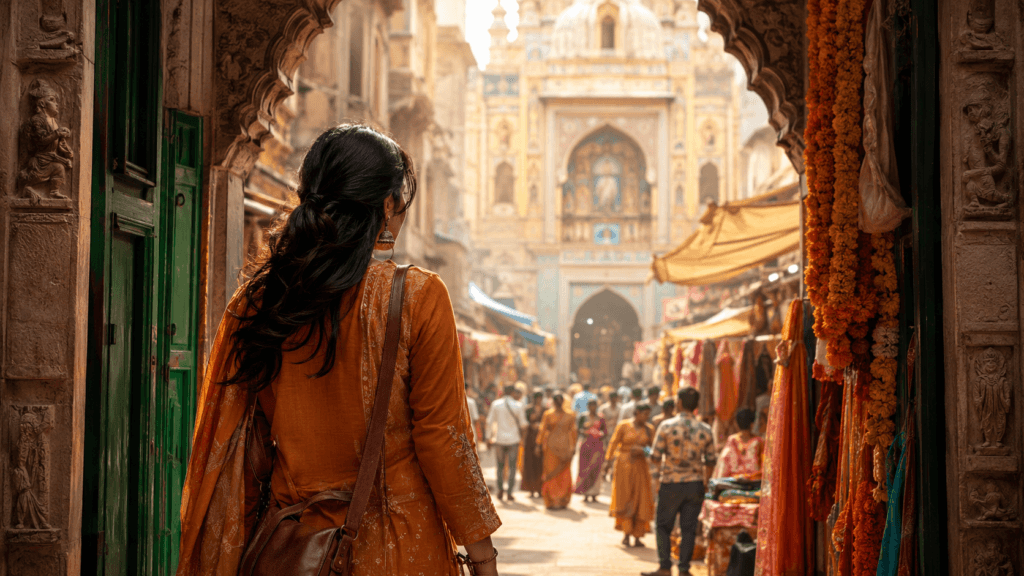
Most women travelling to India for the first time land expecting to feel unsafe. What actually catches them off guard is the intensity: the staring, the noise, the constant attention, the sensory overload. India is rarely unsafe in the way the headlines suggest. It is more intense than you expect, and it arrives all at once.
Every guide for first-time women travellers in India opens the same way. Safety tips. Packing lists. A reminder to be careful. That advice is not wrong. It is just incomplete.
I am Samarth, co-founder of RoamRani, and I have led over 2,500 Taj Mahal tours. I have watched women cry standing in front of it. I have watched others shrug and call it overrated. I have seen travellers arrive terrified and leave refusing to go home. The deciding factor was almost never safety. It was knowing what to expect.
Here are the 10 things I wish someone told every woman before she landed.
What women expect vs. what India actually feels like
| What you expect | What actually happens |
|---|---|
| Safety will be the main concern | Intensity is the real challenge |
| People will leave you alone | You get constant attention: stares, questions, selfie requests |
| Street food is the big risk | Restaurant food is fine; local stomachs are simply built differently |
| Transport will be chaos | One simple hack and you pay close to local prices |
| You will feel guilty saying no to beggars | Saying no is the more honest, more compassionate choice |
| India will match what you read online | India will be almost nothing like what you read online |
1. The real challenge is not safety. It is intensity.
Western media has spent years telling one version of India. Crisis reports. Safety statistics. Dramatic headlines. If that is where you learned about the country, you arrived with the wrong map.
The women I work with do not struggle because India is dangerous. They struggle because India is alive in a way that has no equivalent. Streets that move like rivers. Colour coming at you from every direction. A stranger asking your name, your age, and whether you are married, all in one breath, with a warm smile, because they are curious.
None of that is threatening. But it is a lot, and it arrives all at once.
The women who do well here are not the toughest ones. They are the ones who decide before they land that feeling overwhelmed is part of arriving, not a sign that something is wrong. India is two sides of one coin. The side you focus on shapes the entire trip.
If the safety question is specifically on your mind, we answer it honestly here: Is India safe for solo female travelers? But safety and intensity are not the same conversation.
2. You will get stared at. Openly. Constantly.
This is the one nobody warns you about properly, and it lands harder because of it.
In India, looking openly at a stranger is not considered rude the way it is in the West. People will look at you for a long time without glancing away. At temples, on train platforms, in restaurants, in small towns. If you are a foreign woman, expect it within your first ten minutes.
In almost every case, it is curiosity, not menace. Tourism outside the big cities is still limited, and a foreign woman is still unusual to many people. It is the same instinct that makes any of us look twice at something we rarely see.
What helps: do not hold eye contact waiting for the other person to break. A brief nod, then look elsewhere. You do not need to engage, and you do not need to feel threatened. You just need to know it is coming.
3. The attention has many forms, and it stacks up fast
Staring is only the start. At any busy monument or market, the attention comes from several directions at once.
Photographers offer to take your picture, sometimes for a fee, sometimes hoping to photograph you. Guides walk alongside explaining things you never asked about. Hawkers hold products in front of your face and match your pace until you respond. Children ask for chocolate or money. Strangers ask for selfies with the phone already raised.
Each one is manageable on its own. All of them together, on a hot afternoon near the Taj Mahal gate, is a different experience entirely.
The answer is to decide before you arrive that “no, thank you” is a complete sentence. No explanation. No apology. A calm, repeated no works every time. These interactions are transactional, not personal. Treat them that way and they lose their power to drain you.
4. Clothing is a tool, not just a rule
Every guide tells women to dress modestly. Few explain why it actually matters on the ground.
Covering your shoulders, chest, and knees signals respect in a country where clothing carries real cultural weight. It also lowers the volume of attention you receive. Not eliminates it, lowers it. The difference between a vest and shorts versus a loose cotton kurta at a temple shows up almost immediately in how often and how quickly strangers approach you.
This is not about hiding yourself. It is the same instinct you use choosing what to wear to a formal dinner versus a beach. The setting changes, and the clothing follows.
There are real regional differences most guides skip too. Goa is far more relaxed than Rajasthan, Varanasi, or Agra. What works in one place does not always travel.
We go deep on this in our guide to what to wear in India as a tourist, with fabrics, regional breakdowns, and real packing suggestions. Read it before you pack.
5. Transport is simple once you know one hack
Getting around India looks complicated from the outside. It is not, once you understand how it works.
Auto-rickshaws are everywhere, cheap, and mostly safe. But here is what most blogs will not tell you: at tourist sites, drivers routinely quote foreign visitors double or triple the local fare. It is not personal. It is business.
The fix is simple. Before you agree on a price, open Uber or Ola and check the app’s fare for that exact route. That number sits close to what a local pays. Use it as your opening offer when you negotiate directly. You instantly come across as someone who cannot be overcharged, and the price drops to match.
For longer journeys, hiring a private driver removes nearly every transport headache in a single decision. It costs less than most people expect, especially split between two travellers.
For which apps to trust and how to move safely, see our guide to travel apps for solo women in India. And if you want the easiest possible version from day one, RoamRani’s women-only tours use trained female drivers chosen for safety and reliability.
Before You Book
Talk to someone who actually knows India
The single best thing you can do before your first trip is ask your questions out loud. Book a free consultation call with the RoamRani team and bring everything you have been too embarrassed to ask anywhere else.
6. Local stomachs and your stomach are not the same
Indian food is one of the great joys of visiting the country. Eat as much of it as you can.
But here is the honest truth I tell every traveller: the fact that a local is eating freely from a stall does not make it safe for you. This is not about the food being bad. It is about tolerance built over a lifetime.
Locals have spent years, decades, building resistance to the bacteria, water, and preparation conditions of their region. You have not. They can digest things that would put you in bed for three days. Their bodies have adapted in ways yours has not.
Eat at proper restaurants, especially the first few days. Drink bottled water every single time, no exceptions. Skip raw fruit and vegetables from street vendors unless you can see they have been properly washed, and skip anything that has sat out in the heat.
A little caution in week one keeps the rest of the trip intact. Do not use “the locals eat it” as your benchmark. It will let you down.
7. You do not owe anyone your money, your photo, or your guilt
This might be the most important shift to make before you arrive, and the one nobody names directly.
At temples and monuments you will be approached by beggars, often children. At traffic lights, hands reach through windows. Someone may hold a baby toward you at a gate. If you come from a wealthier country and the contrast is visible everywhere, the guilt that follows feels natural.
But the honest truth is this: giving money to beggars at tourist sites does not solve poverty. It makes begging the most viable option in that exact spot. You are not helping. You are sustaining the thing that keeps people there. There is no guilt in saying no. A calm, kind refusal is not cruelty. It is an honest read of how the economics work.
The same goes for selfie requests, hawkers, and uninvited guides. You owe none of it a yes. Say no once, say it calmly, say it again if you need to. It always works in the end.
8. A good guide changes the entire trip
India is one of the most layered places on earth. Visiting without context is like reading a book in a language you half understand. You catch the broad strokes and miss almost everything that matters.
I have walked thousands of people through the same Taj Mahal. Same building, same light, same crowds. Some stand there and cry. Others leave calling it overrated. The difference is almost never the place. It is whether they understood what they were looking at.
“I came convinced I would last four days and want to go home. By day three I was asking if I could extend my trip. Having someone explain what I was actually looking at changed everything.” Laura M., solo traveller from the UK
If you can budget a private guide at the major sites, do it. At the very least, ask questions everywhere you go. Ask your driver. Ask your hotel staff. Ask the curious locals who approach you. People in India are warm and generous with what they know when you ask with real interest. The discomfort almost always comes from staying closed.
9. Where you stay shapes everything else
Accommodation matters more in India than almost anywhere, and the wrong choice is hard to undo mid-trip.
A centrally located hotel in a well-established part of town means shorter travel times, faster orientation, and access to what you came for without adding a layer of navigation to a place that already asks a lot of your attention. A cheaper room in an unfamiliar neighbourhood adds quiet stress to every single outing.
Read recent TripAdvisor reviews, specifically from women travelling alone. The star rating is a starting point. The written reviews from solo women tell you far more. Stick to the last six months, and skip cheap backpacker hostels unless someone you trust stayed there recently.
At RoamRani, every hotel we recommend has been visited in person with women travellers in mind. If you would rather skip the research, get in touch and we will hand you a vetted shortlist.
10. The one thing to do before you land
For years, India’s image abroad was built on its worst moments. The algorithm rewarded fear, and generations of women either stayed away or arrived carrying anxiety borrowed from stories that had nothing to do with their actual trip.
That is changing. A new generation of travellers is posting honest, joyful footage from India, the warmth of its people, the beauty of its sites, the food, the colour, the wonderful madness of it. India is not what the old headlines suggested.
But watching someone else’s trip on a screen is not the same as being ready for your own. Closing the gap between “India looks incredible” and “I know exactly what to expect” takes a little real preparation.
Before you go, read through the journal and download our free India guide. From the Golden Triangle to clothing, food, safety, and transport, it is written specifically for women by people who have guided thousands of them. Bring your questions. There is no such thing as one too basic.
Questions women ask before travelling to India for the first time
Is India safe for women travelling alone?
India is safe for women who travel with preparation and awareness. The most common challenge is not danger but intensity: constant attention, sensory overload, and cultural differences that catch first-time visitors off guard. Millions of women travel India every year without incident. The key is knowing what to expect before you arrive.
What should women wear when travelling to India?
Cover your shoulders, chest, and knees as a baseline, especially at temples, monuments, and in smaller towns. Loose cotton or linen in longer cuts works well in the heat. Regional norms vary: Goa is far more relaxed than Rajasthan or Varanasi.
How do women get around safely in India?
Hiring a private driver is the most comfortable option for first-time visitors. For auto-rickshaws, check the fare on Uber or Ola first, then negotiate directly using that number as your starting point. Apps like Ola and Rapido are usually safe for solo women and widely available in cities.
What food should women avoid in India?
Avoid raw fruit and vegetables from street vendors unless visibly washed, anything sitting out in heat, and tap water. Always drink bottled water. Eat at proper restaurants for the first few days while your stomach adjusts, and do not treat locals eating street food as your safety guide. Their tolerance is built over a lifetime.
Do I need a tour guide as a woman travelling to India?
A guide is not required, but it changes the experience significantly. India is deeply layered, and having someone explain what you are seeing turns a confusing day into a meaningful one. At minimum, hire a guide for the major sites.
The women who leave India not wanting to go home
I have watched thousands of women arrive carrying anxiety borrowed from other people’s stories. Most of them transform within two days, because India does not give you much room to stay inside your own head. It asks for your attention constantly, from every direction.
It is loud. It is layered. It can be chaotic and breathtaking on the same street. The traveller who looks for the glass half empty will find plenty to complain about. The traveller who looks for it half full will be checking return flights before the trip is even over.
Across more than 2,500 tours, it comes down to preparation and perspective almost every time. You now have the first. The second arrives the moment you land.