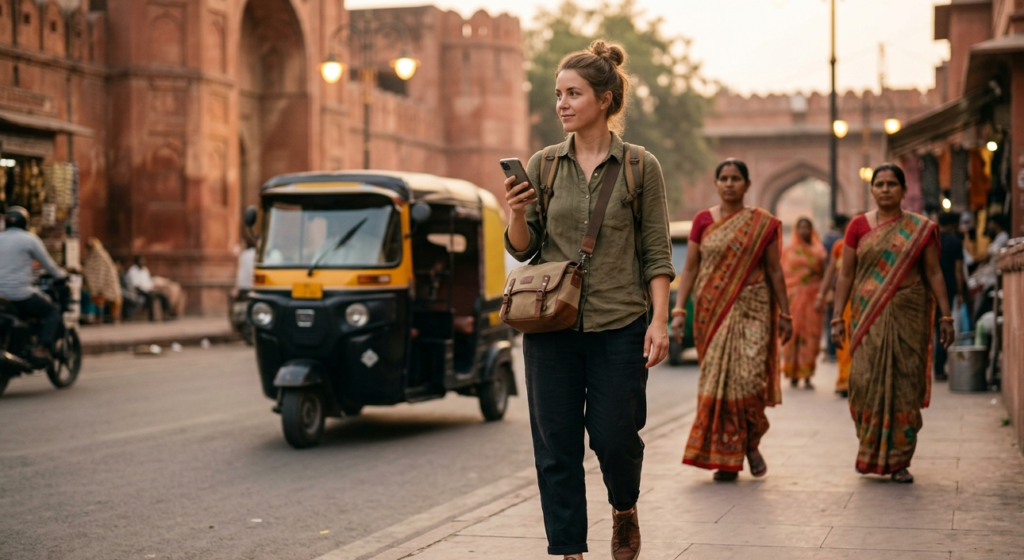
You’ve done the research. You’ve seen the headlines. And now you’re asking yourself: is India actually safe for a woman travelling alone?
Your worry isn’t wrong. It’s just incomplete.
India is unlike anywhere else in the world. The noise, the crowds, the stares, the strangers who approach you with a smile and sometimes with an agenda. I’ve guided women through all of it, from the backstreets of Delhi to the desert forts of Rajasthan. And the pattern I’ve seen, every single time, is this: the women who prepared well didn’t just cope with India. They fell in love with it.
The difference between those two trips often comes down to having the right information before you land. Apps are part of that. But only part. I’ll come back to what matters more at the end.
Before You Download Anything, Sort This First
Every app on this list needs internet to work. Your home SIM’s roaming plan will either drop out in rural areas, drain your data, or cost you far more than it should. In India, that’s a safety risk, not just an inconvenience.
At RoamRani, we give every woman traveller an Indian SIM card with unlimited data before the journey starts. Not as a perk. As a safety measure. When you have consistent connectivity, you can share your live location, call for help, look up anything, and navigate without guessing. Without it, you’re isolated in a country you don’t yet know.
Get a local SIM. Everything else depends on it.
The Apps Worth Having
1. Google Maps and Live Location Sharing
What it’s actually for: Letting someone know where you are, always
Before you leave your hotel, whether you’re heading to a market, a monument, or an evening walk, share your live location with someone you trust. A family member back home. Your tour operator. Your driver.
This one habit is worth more than any dedicated safety app on the market. If something goes wrong, someone already knows exactly where you are.
On iPhone, use Find My Friends. On Android, share your location through Google Maps. At RoamRani, we ask all of our women to share their live location with us throughout the trip. It sounds simple because it is. Simple things save people.
2. 112 India
What it’s actually for: Calling for help fast
112 is India’s national emergency number, the same as 911 in the US or 999 in the UK. The 112 India app lets you trigger an SOS alert that sends your exact location to emergency services in seconds.
Download it before your flight. Store the number in your phone. You probably won’t need it. But knowing it’s there changes how confidently you walk.
3. Himmat Plus
What it’s actually for: A direct line to local police
Built by the Delhi Police, Himmat Plus connects you to the nearest police control room with one button press and your real-time location. It’s most reliable in Delhi, which is worth knowing because that’s where most international flights land.
4. My Safetipin (The One Most Women Have Never Heard Of)
What it’s actually for: Knowing which streets are actually safe
The question I hear most often from women before they arrive is: “How do I know if it’s safe to walk around near my hotel?”
Google Maps won’t tell you. Your hotel might not either. My Safetipin will.
The app uses crowdsourced safety data to rate areas based on lighting, foot traffic, open sightlines, and how many people are around. India has streets where you can walk comfortably at 9pm, and streets two minutes away where you shouldn’t. The difference isn’t always obvious. My Safetipin shows you the difference.
5. ChatGPT or Claude (Skip Google Translate)
What it’s actually for: Understanding what’s actually going on around you
Most people pack Google Translate and think they’re covered. In India, it struggles. Regional dialects, different scripts, spoken context that doesn’t translate cleanly. For a country with 22 official languages, you need something smarter.
AI apps like ChatGPT or Claude handle nuanced translation much better. More importantly, they give you context, not just words. You can ask: “Is 500 rupees a fair price for an auto-rickshaw from Connaught Place to India Gate?” and get a real answer. You can describe a sign, a food label, a conversation you half understood, and get something useful back.
Most Indians understand basic English but may not speak it confidently. A little patience and an AI app in your pocket go a long way.
6. XE Currency
What it’s actually for: Knowing what you’re actually paying
India is largely cash-based outside of major hotels. You’ll handle rupees every day: in markets, at temples, for tips, for street food. Without a live exchange reference, you’re guessing at every transaction.
XE Currency gives you real-time exchange rates so you can make confident decisions on the spot. When someone quotes you 1,200 rupees for a pashmina, you’ll know immediately if that’s reasonable or not.
7. TripAdvisor
What it’s actually for: Catching scams before they catch you
Here is one of the most common scams I’ve seen play out: a stranger approaches a woman outside a monument and tells her it’s closed today. A holiday. A private function. Some vague government restriction. She turns around. The monument was open the whole time. The stranger was steering her towards a shop where he earns commission.
Always check TripAdvisor before you turn back. Look at photos posted in the last few days. If visitors are inside, you’ll see them. Thirty seconds of checking saves hours of your trip.
TripAdvisor is just as important for checking hotels, restaurants, guides, and drivers before you trust them. Read the recent reviews. Look for patterns, not one-off complaints.
8. Book Monument Tickets Online Before You Go
What it’s actually for: Skipping the queue and skipping the scammers
This isn’t an app, it’s a habit. And it’s one of the most practical things on this list.
The Taj Mahal queue can run two to three hours on a busy day. Booking online through India’s Archaeological Survey of India portal in advance means you skip the queue, often pay less than the on-site price, and have nothing to prove to anyone at the gate. When you already have your ticket, the person who offers to “help you get in faster” has nothing to offer.
9. IRCTC, But Know Its Limits
What it’s actually for: Train travel, with one important catch
India’s trains are an extraordinary way to travel. Affordable, atmospheric, genuinely memorable. The IRCTC app is how Indians book them.
The catch: IRCTC doesn’t accept most international credit or debit cards. Many women arrive expecting to book independently and hit a dead end.
The fix is straightforward: book through a local tour operator who handles the ticket for you. You get the same train, the same seat, without the payment headache.
The One to Be Careful With: Uber and Ola
Let me be honest about something here, because most travel blogs won’t say it.
RoamRani exists because of an Uber experience.
My wife and co-founder Chetna felt unsafe in an Uber in Delhi, her own city. When she tried to report it, she found that Uber has no real-time customer support line. No one you can call. No one who can help you while something is still happening. For a woman in an unfamiliar country, that is a serious problem.
Uber and Ola drivers are not police-verified. There is no accountability system that kicks in quickly when you need it. These apps have a place as a last resort in a genuine emergency, but they should not be your default way of getting around.
Use an operator with verified, GPS-tracked vehicles. It costs a little more and it is worth every rupee.
The RoamRani App Is Coming
We’re building a single app for women travelling in India: verified transport, real-time safety support, trip planning, and emergency contacts, all in one place. It doesn’t exist yet, but it’s coming.
Sign up to hear when it launches
The Thing That Matters More Than Any App
Every app on this list helps. None of them replaces having a local person who picks up when you call and can physically show up when you need them.
India has a learning curve that apps can’t fully navigate. Knowing which streets to avoid, how to negotiate without getting taken advantage of, which drivers to trust, which guides are genuine. That knowledge comes from people who know the country, not from a screen.
Before you board the plane, speak to someone with real experience on the ground. Read, research, and ask people who have actually guided women through India, not just written about it from a distance.
At RoamRani, we offer a free consultation call to any woman planning to travel to India, solo or with friends. No sales pressure, no obligation. Just honest guidance from a team that has been doing this for years.
Frequently Asked Questions
Is India safe for solo women travellers?
India can absolutely be safe for solo women, with the right preparation. The risks are real but manageable. Knowing which areas to avoid, how to get around with trustworthy transport, and having local contacts you can reach in a moment makes a huge difference. Thousands of women travel India solo every year and come home changed for the better.
What is the most important app for solo women in India?
A live location sharing app, like Google Maps or Find My Friends. Sharing your real-time location with someone you trust, whether that’s a family member at home or your tour operator on the ground, is the single most effective safety habit you can build.
Do I need a local SIM card in India?
Yes. Most apps need internet to work, and roaming coverage in rural India is unreliable and expensive. A local Indian SIM with unlimited data keeps you connected wherever you go.
Is it safe to use Uber or Ola in India?
With caution. Drivers are not police-verified, and getting real support quickly is difficult if something goes wrong. Use verified, GPS-tracked transport from a trusted operator for your day-to-day travel. Keep Ola or Uber as a backup option only.
How do I book train tickets in India as a foreigner?
IRCTC, India’s official train booking platform, does not accept most international cards. Book through a local tour operator who can handle the transaction. You still get the full train experience, just without the payment frustration.
What should I do before I travel to India for the first time?
Research thoroughly and talk to someone with local knowledge before you arrive. Understanding India’s cultural norms, how to navigate transport safely, and which areas suit solo women takes time. A short consultation call with an experienced local operator can save you weeks of confusion and several costly mistakes.
The App Checklist
| App or Tool | What It Does |
|---|---|
| Google Maps / Find My Friends | Share live location with trusted contacts |
| 112 India | National emergency SOS |
| Himmat Plus | Direct police SOS, especially useful in Delhi |
| My Safetipin | Neighbourhood safety ratings from real data |
| ChatGPT / Claude | Translation and local context |
| XE Currency | Live exchange rates |
| TripAdvisor | Verify guides, hotels, and whether monuments are open |
| ASI Ticket Booking | Pre-book monuments, skip the queue |
| IRCTC (via operator) | Train travel booked through a local operator |
| Ola / Uber | Last resort only |
India will challenge your assumptions and surprise you in ways you didn’t expect. The women I’ve guided who prepared well always say the same thing on their last day: “I wish I had come sooner.”