The short answer: Loose, lightweight clothing that covers your shoulders and knees. Cotton or linen. A scarf in your bag at all times. Slip-on shoes for temple visits and a spare pair of thin socks kept in your day bag. That covers you in 90% of situations across India.
I have been travelling across India for years, and I hear this question more than almost any other from women planning their first trip. It deserves a straight answer, not a list of vague suggestions that leaves you standing in front of your wardrobe still unsure what to pack.
More than that, there are specific things that do not always make it into a pre-trip briefing, even from experienced guides. I want to cover those first, because being caught off guard at the entrance to a Gurudwara or a major temple is not the kind of thing you forget in a hurry.
This guide covers women and men, all the major regions, every season, and every type of site you are likely to visit. Whether you are planning a Golden Triangle trip, travelling solo, or putting together your first India itinerary from scratch, this is what you actually need to know.
Why Clothing Matters More in India Than Most Destinations
In most countries, what you wear is broadly a personal choice. In India, it determines where you can go, how people interact with you, and whether you have a comfortable day or a frustrating one.
Dress inappropriately and you will be turned away at the entrance to some of India’s most extraordinary temples. You will draw more attention in crowded markets than you want. You will overheat if you pack heavy Western fabrics, and you will be cold if you assume India is always warm.
Get it right and the experience shifts noticeably. Temple guards wave you through. Locals respond warmly to the effort. You move through busy bazaars with more ease. And the right clothing in India is often genuinely more comfortable than anything you would have packed from home.
The Things Your Guide Might Forget to Tell You
These are the practical details that do not always make it into a pre-trip briefing. Not because guides are careless, but because they have covered the same ground so many times that certain things stop feeling like information worth mentioning. For a first-time visitor, they matter a great deal.
At Gurudwaras, Everyone Covers Their Head — Including Men
This catches visitors off guard more than almost anything else. The Golden Temple in Amritsar is one of the most visited sites in India, and I still see people arriving unprepared because nobody told them directly: at a Gurudwara, covering your head is mandatory. Not optional, not a polite gesture. Mandatory. For everyone.
The Gurudwara provides cloths at the entrance if you do not have your own. But if you want to arrive with some composure and not scramble at the door, carry a cotton scarf or a lightweight bandana in your bag from the first day of your trip. It weighs nothing and solves the problem every single time.
At Hindu Temples, You Remove Your Shoes — Carry a Spare Pair of Socks
Shoe removal at temple entrances is widely known. What is less often mentioned is that the floor inside many temples, and the stone paths leading up to them, can be rough, dusty, very hot in the afternoon sun, or wet near water features and washing areas.
A spare pair of thin socks kept in your day bag makes a noticeable difference. You remove your shoes, slip on the socks, and you are comfortable on whatever surface is inside. It also makes the whole process faster when you are visiting three or four sites in a single day and removing footwear each time.
Slip-on sandals or shoes without laces are far easier to manage than lace-ups when you are doing this repeatedly.
In Crowded Markets and Bazaars, Covering Up Is About More Than Modesty
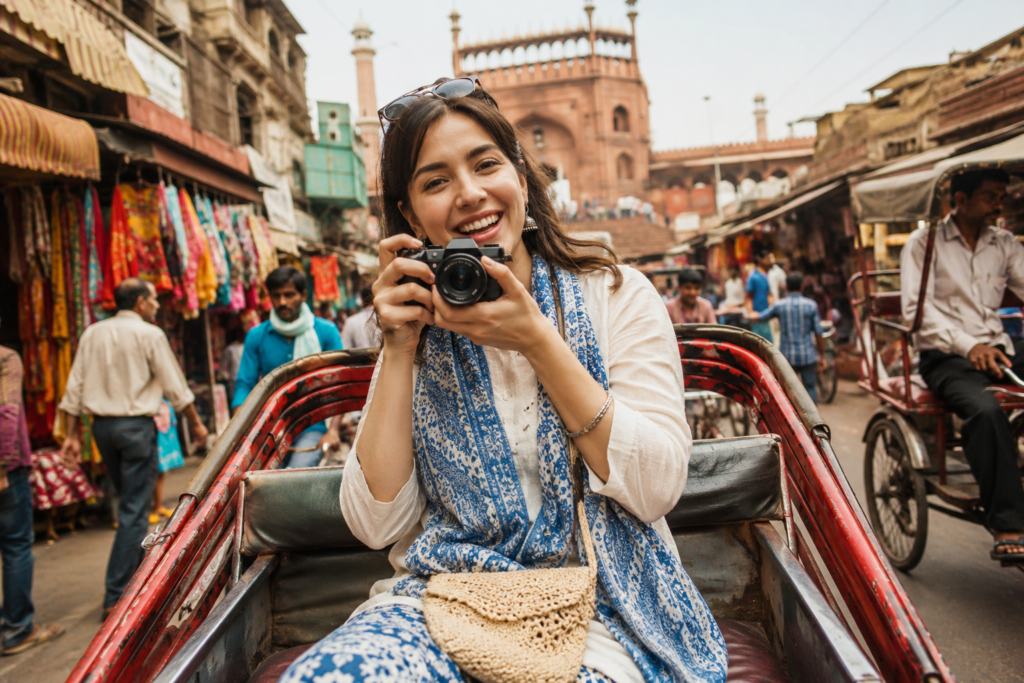
India’s bazaars are some of the most alive places I have ever been. Chandni Chowk in Delhi, the pink city markets of Jaipur, the old quarter in Varanasi. They are also extremely crowded, and in those conditions, wearing clothing that covers your arms and legs genuinely reduces unwanted physical contact and helps you move through with less friction.
This is practical advice, not a restriction. A loose cotton kurta or linen trousers are also cooler than tight jeans in the heat, which means covering up is both the safer and the more comfortable choice in these settings. Most women travelling with us find they actively prefer it within the first day or two.
What to Wear in India: Women’s Complete Guide
For Everyday Sightseeing
The most versatile option for sightseeing anywhere in India is a cotton or linen kurta worn over loose trousers or leggings. This combination works in cities, temples, markets, restaurants, and train journeys. It is cool, appropriate by local standards, and easy to move in.
Other options that work consistently well:
- Maxi dresses or midi skirts with a light top that covers the shoulders
- Loose linen trousers with a short-sleeved top
- Salwar kameez sets (widely available across India and significantly cheaper to buy there than to bring from home)
Western clothing like jeans and a t-shirt is perfectly acceptable in cities like Delhi, Bangalore, and Mumbai, particularly in hotel areas, restaurants, and shopping centres. But for a full day of intensive sightseeing, the Indian options are genuinely more comfortable in the heat. This is not about aesthetics. It is about how you feel eight hours into a day at 38 degrees.
For Temples and Religious Sites
The rule across almost every religious site in India is the same: cover your shoulders and knees. No sleeveless tops, no shorts, no low necklines.
A lightweight scarf worn over your shoulders is the most practical solution when you want to wear something more casual and need to cover up quickly. Every woman travelling with RoamRani carries one from day one. It doubles as a sun cover, a head covering at Gurudwaras, a layer on cold evenings, and a temple wrap. One item, used constantly.
For particularly conservative sites, including the ghats at Varanasi and major pilgrimage temples in South India, full-length clothing and no exposed midriff is the standard. When in doubt, more coverage is always the right call.
For Gurudwaras (Sikh Temples)
Requirements at every Gurudwara: head covered, shoes removed, legs covered. The Gurudwara provides head cloths at the entrance, but bringing your own scarf is easier and faster.
At the Golden Temple specifically, there is one step most visitors are not warned about: before entering, you wash your feet in a pool of water at the entrance. You will be walking on wet marble inside. Socks make this significantly more comfortable, and they dry quickly. Wear shoes you can remove in seconds.
For Crowded Markets and Bazaars
Full-length, loose-fitting clothing is the right choice for India’s busy market areas. A kurta with trousers, a maxi skirt with a loose top, or a light cotton dress that covers the knees. Keep your scarf accessible. Avoid shorts, crop tops, or anything tight-fitting in these settings specifically.
For Beaches (Goa, Kerala, Andaman Islands)
Beach destinations operate by different norms. Swimwear, bikinis, and shorts are entirely acceptable on the beach and at beach-facing restaurants and resorts. The moment you move into a town, a market, or any inland area, the same guidelines apply as everywhere else in India.
A light cotton wrap or a long-sleeved shirt that fits into your day bag is all you need to move between settings.
Quick Reference: What to Wear Where
| Situation | What to Wear | What to Avoid |
|---|---|---|
| City sightseeing | Kurta, loose trousers, maxi dress, linen separates | Tight clothing, deep necklines |
| Hindu temples | Shoulders and knees covered, scarf, slip-on shoes, socks in bag | Sleeveless tops, shorts, lace-up shoes |
| Gurudwara | Head covered, full-length clothing, slip-on shoes, socks | Bare head, shorts, tight jeans |
| Mosque | Head covered (women), full-length clothing, shoes off at entrance | Sleeveless, shorts, visible midriff |
| Crowded bazaars | Loose full-length cotton or linen, covered arms | Shorts, tight clothing, sleeveless tops |
| Beach (Goa, Kerala) | Swimwear on the beach, cover-up when leaving | Beachwear in towns, markets, or inland |
| Restaurants and hotels | Smart casual works in most settings | Nothing specific in most cases |
What to Wear in India: Men’s Guide
Men have a more straightforward time with clothing in India. Lightweight trousers and a short-sleeved collared shirt covers most situations, including temple visits and restaurants. Shorts are fine on the beach and at resorts but should be avoided at all religious sites.
Key reminders that are easy to overlook:
- At Gurudwaras, you cover your head too. This surprises a lot of male visitors. A small cloth or bandana works perfectly. The Gurudwara provides one at the entrance if you do not have your own, but being prepared is better.
- At temples, remove your shoes and carry socks. The same advice applies regardless of gender. Thin socks in your day bag are worth the space.
- Linen shirts are the single most practical item to pack. They breathe well, pack easily, and are acceptable in almost every setting, from a heritage hotel dinner to a temple entrance.
- Loose trousers are more comfortable than jeans in the heat, particularly from March onwards across North India. Cotton chinos or linen trousers are worth bringing even if you would not normally wear them at home.
India Clothing Guide by Region
North India and the Golden Triangle (Delhi, Agra, Jaipur)
The Golden Triangle is India’s most visited circuit and one of the most concentrated areas for temples, mosques, and historical monuments. Appropriate clothing matters here as much as anywhere in the country.
Delhi’s Jama Masjid requires women to cover their heads and wear full-length clothing. The mosque provides coverings at the entrance, but wearing a scarf and loose trousers from the start means you walk straight in. Delhi in summer reaches 40 to 45 degrees. Lightweight cotton and linen are not just culturally appropriate here. They are physically necessary.
Jaipur’s bazaars are among India’s most vibrant and also among its most crowded. Full-length loose cotton clothing is ideal. The same applies in Agra, where the streets around the Taj Mahal draw enormous crowds throughout the day.
For North India, pack:
- 3 to 4 cotton kurtas or loose linen shirts
- 2 to 3 pairs of loose cotton or linen trousers
- A lightweight scarf (not optional)
- Comfortable slip-on sandals
- A spare pair of thin socks in your day bag
- A light jacket or warm shawl for evenings from October to February
Rajasthan
Rajasthan is desert terrain, and the local tradition of wearing bright, flowing, block-printed cotton is both beautiful and entirely practical. If you plan to buy any clothing during your India trip, buy it here. Jaipur and Jodhpur both have extraordinary fabric markets, and a hand-block-printed cotton kurta from Rajasthan will serve you better for the rest of your trip than most things you packed from home.
Winters in Rajasthan (November to February) are cold, particularly at night and in the early morning. Pack a lightweight down jacket or a warm wool shawl for evenings. Days can still be warm enough for cotton layers, so dressing in adaptable pieces is key.
South India (Kerala, Tamil Nadu, Karnataka)
South India is humid rather than dry, which makes breathable fabrics even more critical. The dress code at major temple complexes in Tamil Nadu, including Madurai’s Meenakshi Temple, is often stricter than in North India. Shoulders, knees, and midriff must all be covered, and some inner sanctum areas require specifically Indian-style clothing at certain points.
Cotton and linen remain the best choices throughout. The approach is the same as elsewhere: a base of modest clothing with a scarf for additional coverage when needed.
Goa and Coastal India
Goa is the most relaxed dress environment in India. On the beach and in beach town areas, Western summer clothing is entirely normal. Moving inland, visiting a church, a temple, or a market, the standard India guidelines apply immediately.
For a trip that combines coastal areas with other destinations, a light wrap that fits into a day bag is all you need to move between settings without planning outfit changes.
The Himalayas (Himachal Pradesh, Uttarakhand, Ladakh)
The Himalayas require a completely different approach. Even in summer, temperatures drop after sunset and at altitude, and many areas are cold throughout the day.
- Thermal base layers
- A fleece or lightweight down mid-layer
- A waterproof outer layer
- Warm socks and proper walking or trekking shoes
The cultural notes still apply: Hindu temples and Buddhist monasteries both require shoes off and modest clothing. In Buddhist monasteries, hats are generally removed before entering the main prayer hall. Carry your scarf regardless of the temperature.
What to Wear in India by Season
| Season | Months | Temperatures (North India) | What to Pack |
|---|---|---|---|
| Winter — peak travel season | October to February | 8 to 25°C | Layers: cotton and linen days, a warm shawl or light jacket for evenings and early mornings |
| Spring | March to April | 20 to 35°C | Light cotton and linen; scarf doubles as sun cover |
| Summer | May to June | 35 to 45°C | Ultra-lightweight cotton only; sun hat; breathable sandals |
| Monsoon | July to September | 25 to 35°C with high humidity | Quick-dry fabrics; waterproof sandals or shoes; a compact travel umbrella |
Footwear for India
Slip-On Sandals or Shoes: Non-Negotiable
You will remove your shoes at temple entrances throughout your trip, sometimes multiple times in a single day. Sandals, slip-ons, or anything without laces makes this far less frustrating. A good pair of flat, comfortable sandals or quality slip-on shoes covers the vast majority of situations.
One Pair of Proper Walking Shoes
Sites like Mehrangarh Fort in Jodhpur, the ghats in Varanasi, and many heritage complexes involve uneven stone surfaces and long distances on foot. One pair of comfortable walking shoes with reasonable arch support is worth bringing alongside your sandals.
The Socks Rule
Keep a spare pair of thin socks in your day bag every single day. When you remove your shoes at a temple, the stone floor can be dusty, hot from the afternoon sun, or wet near water features. Thin cotton or bamboo socks take up almost no space and solve the problem completely. This is the single most practical packing tip I give every traveller before they leave.
What Tourists Should Not Wear in India
- Shorts in cities and at religious sites. Fine on a beach or at a resort. Not appropriate in temples, markets, or most urban sightseeing environments.
- Sleeveless tops without a scarf. A sleeveless top on its own will cause problems at every religious site and in most markets. Carry a scarf and the problem is solved.
- Deep necklines or crop tops. These draw unwanted attention and will prevent entry to temples and many sacred sites.
- Very tight clothing. Beyond being culturally misaligned with most of India outside of specific urban areas, tight synthetic fabrics in serious heat are also genuinely uncomfortable.
- Swimwear away from the beach. Even in Goa, wearing swimwear into town or a market is considered disrespectful and will attract significant attention.
- White or very pale fabrics as your only option. Dust, pollution, and busy streets are realities across India. Pack colours, or accept that white will not stay white for long.
Buy Clothes in India: The Smarter Approach to Packing
Here is something I tell every traveller before they spend hours agonising over what to pack: India has extraordinary textiles at a fraction of what they cost at home.
A hand-block-printed cotton kurta in Jaipur costs roughly 400 to 1,500 rupees, well under fifteen pounds or twenty dollars. A quality salwar kameez set is similar. Fabric markets in Rajasthan, Kerala, and Tamil Nadu are genuinely world-class. You can arrive with a week’s worth of basics and buy what you actually need once you understand the environment you are in.
The practical implication: do not overpack. Bring versatile basics and leave room in your bag. Most of the women who travel with RoamRani end up wearing their India purchases for the entire second half of the trip. It is a better system than trying to anticipate everything from a bedroom in another country.
India Clothing Packing List
For a 10-day trip covering the Golden Triangle and Rajasthan, this is what I would pack.
Women
- 3 to 4 cotton or linen kurtas (plan to buy one or two in India)
- 2 pairs of loose cotton or linen trousers
- 1 pair of travel trousers or comfortable jeans for cooler evenings
- 2 fitted cotton tops for urban settings or layering under kurtas
- 1 lightweight scarf or dupatta — use it for everything
- 1 light jacket or warm shawl for North India evenings, October to March
- 1 pair of comfortable slip-on sandals
- 1 pair of walking shoes
- 3 pairs of thin socks, with one always in your day bag
- A swimsuit if visiting coastal areas or a hotel with a pool
Men
- 3 to 4 linen or cotton shirts
- 2 to 3 pairs of lightweight chinos or linen trousers
- 1 pair of slip-on sandals or loafers
- 1 pair of comfortable walking shoes
- A small cloth or bandana for head covering at Gurudwaras
- 3 pairs of thin socks
- A light jacket or warm layer for evenings in North India
Free 30-Minute Call
Not sure which route is right for you?
Let’s figure it out together.
Tell us a little about what you’re looking for and we’ll send you initial thoughts within 24 hours. If it helps, we’ll schedule a free call to talk through your options. No pressure, no sales pitch.
Personal reply within 24 hours
No automated responses
Free consultation call available
Frequently Asked Questions
What should women wear at the Golden Temple in Amritsar?
At the Golden Temple, men and women must cover their heads, remove their shoes, and wash their feet before entering. Full-length, modest clothing is required. The Gurudwara provides head coverings at the entrance, but bringing your own scarf is easier. Thin socks are strongly recommended for walking on the marble floors, which can be hot, cold, or wet depending on the time of day. Wear shoes you can remove in seconds.
Can I wear shorts in India as a tourist?
Shorts are appropriate on beaches and at resorts. In cities, markets, and at all religious sites, shorts should be avoided for both men and women. In rural areas, women in shorts attract significant unwanted attention and it is best to avoid them entirely. Men in shorts face fewer reactions in urban settings but should always change before visiting temples or other religious sites.
What fabrics work best for travelling in India?
Cotton and linen are the right choices for most of India. They breathe well in the heat, dry reasonably quickly during monsoon season, and are available in every market across the country. Avoid synthetic fabrics wherever possible. They trap heat and are noticeably uncomfortable during the hotter months, which covers a large portion of the year across much of the country.
Do I need to cover my head as a tourist in India?
At Gurudwaras, covering your head is mandatory for everyone, men and women. At mosques, women should cover their heads. At Hindu temples, head covering is not usually required but is respected. One lightweight scarf in your bag resolves all of these situations without needing to think about it each time.
Can I wear sleeveless tops in India?
Sleeveless tops are fine in hotel environments, on the beach, and in some urban cafes and restaurants. They will cause problems at any religious site and in conservative markets and smaller towns. The practical answer: carry a scarf or a light shirt to cover your shoulders whenever you step into a temple, a market, or a less urban environment.
What should I wear when visiting the Taj Mahal?
The Taj Mahal is a Mughal monument and mosque complex. Modest clothing covering shoulders and knees is expected. You remove your shoes before entering the main mausoleum, so slip-on footwear and a pair of socks in your bag make the visit considerably more comfortable. Early morning visits, which are the best time to go, can also be cool, so a light scarf or jacket is worth having.
What is the best way to dress for a mixed itinerary that includes beaches and cities?
Pack modest clothing as your base and add a light wrap for beach days. Cotton trousers, a few kurtas or loose tops, and a scarf cover the city and temple days. A swimsuit and a light wrap handle the coastal days. You do not need two separate wardrobes. The overlap is large, and India’s markets can fill any gaps inexpensively once you arrive.
Is it safe to wear jewellery in India as a tourist?
Simple jewellery is perfectly fine. Leave expensive or high-value pieces at home or in your hotel safe. Visible expensive jewellery in crowded markets is best avoided. This applies broadly when travelling anywhere with dense, busy crowds, not just India specifically.