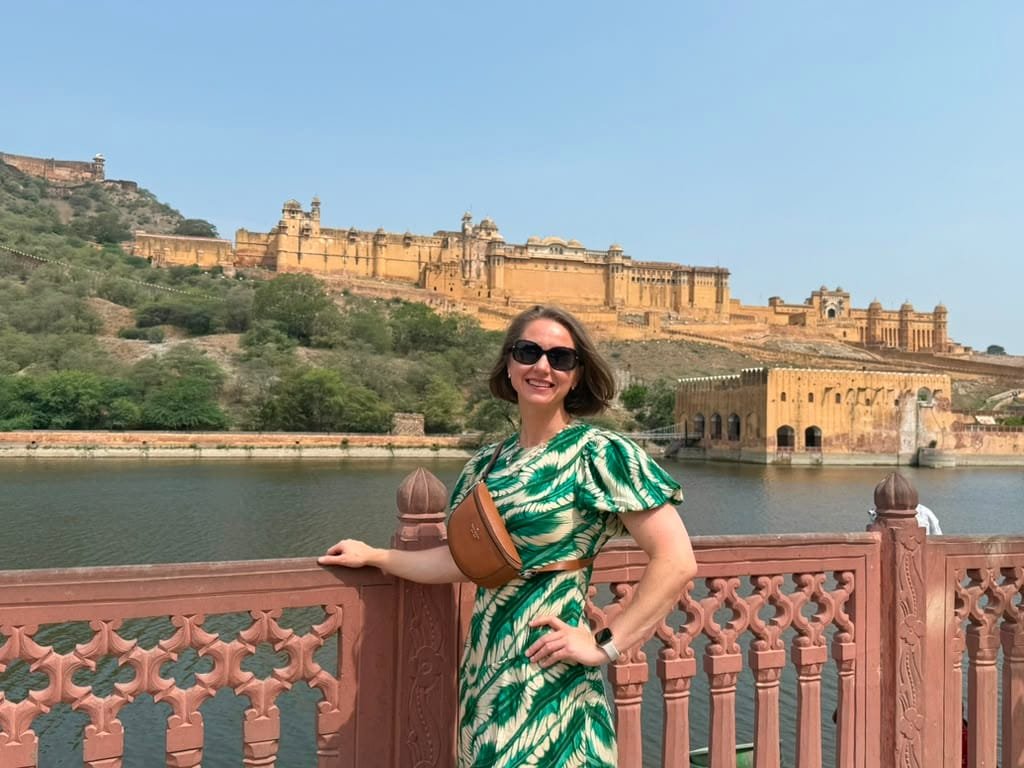
Yes, India is safe for solo female travelers who travel smart. Millions of Indian women move around this country every single day. The difference is they know how: pre-book your transport, keep to daylight for anything new, and lean on the crowd around you. If you want the freedom of solo without the logistics, a small women-only group tour is the safest way in.
The first time someone tried to scam me was outside my own hotel in Jaipur. I flagged an auto from the street, the driver quoted a fare to Amer Fort so cheap I thought I had won something, and twenty minutes later we were parked outside a “handicraft emporium” I never asked to see. That is the oldest auto scam in the book: the cheap fare is the bait, and the shop pays the driver a commission to keep you inside long enough that you lose half your day.
I am Chetna. I have travelled solo across a lot of this country, from Jaipur’s bazaars to Bengaluru’s cafes to the quiet of Dharamshala and Amritsar, and I want to tell you something the scary headlines will not: traveling solo in India is a skill, and you do not develop it in one day. Once you have it, India is one of the most rewarding places a woman can travel alone. Let me show you how it actually works.
Is India safe for solo female travelers?
Honestly, yes, with common sense. India is a country like any other, and the women who live here travel it constantly. The fear you have read about online is overblown. What trips up first-timers is not danger so much as discomfort: the staring, the noise, the constant attention. Discomfort is not the same as danger. Most people you meet will be genuinely kind and want to help. The small number who try something are usually after your money, not you, and they back off the moment you stop being an easy target.
If you have already searched “is India safe,” you have probably half-decided to come. Good. The real question is not whether to go, it is how to go safely. That is the part worth your attention.
What about the horror stories on Reddit and the news?
They are real, and they are also a tiny slice of millions of safe trips that never make the news. My honest take: the fear is overblown, and common sense closes most of the gap. You would not walk down an empty street at 2am in Paris or New York either. India asks for the same street sense, plus a little cultural homework. The women who struggle here are usually the ones who arrived expecting it to feel like home. It will not, and that is the point of coming.
What actually keeps you safe on the ground
Here is what “travel right” means in practice, whether you are with us or on your own.
- Pre-book your transport. Never take a fare off the street that is suspiciously cheap, that cheap number is the setup for the shop detour. Book cars through a trusted tour operator instead of hailing them. App cabs seem easy, but you often get a car with no English, no real safety net, and no customer support if something goes wrong at 11pm.
- Move in daylight for anything new. Save the unfamiliar neighbourhoods, long transfers, and first-time areas for daytime. Evenings are for places you already know.
- Do not over-copy what you see locals doing. Indians navigate their own cities with a lifetime of context you do not have yet. Hanging off a train, wandering a deserted lane at night, trusting a stranger’s shortcut, that is their local knowledge, not yours.
- Do not engage random strangers from the street. A firm, direct “no” works far better than a polite smile. Politeness reads as an opening here. Be a little like a New Yorker: keep walking.
- Use the crowd. This is the part foreign guides miss. As a foreign woman you already have a lot of attention, so use it. The second a tout will not leave you alone or something feels off, call out to nearby locals or other travellers. People will step in for a foreign tourist, almost every time.
- If you are going fully solo, stack the odds. Stay in well-reviewed hostels, find travel companions inside them, keep your days out in daylight, and skip the random street invitations. Or take a women-only group tour and let someone else carry the logistics.
For the city-specific version of this, my honest reads on Jaipur, Agra, and Rajasthan go deeper, and there are ten things no one tells women before they come that are worth reading first.
Solo, a big group tour, or a small women-only group?
Most women land on one of three ways to see India. Here is the honest trade-off.
| Option | Freedom | Safety net | Best for |
|---|---|---|---|
| Fully solo (DIY) | Total | You are it | Experienced solo travellers who enjoy the logistics |
| Large mixed group tour | Low, fixed itinerary | Shared, impersonal | People who want zero planning and do not mind a set schedule |
| Small women-only group | High, flexible | Female guide, vetted driver, small group | First-timers who want freedom without the risk |
The problem with going fully solo your first time is the mental load: every cab, every price, every “is this okay” is on you. The problem with a big generic bus tour is the opposite, you trade all your freedom for safety and end up behind glass, never really touching the place. The middle path is a small women-only group, and it is the one I would send my own sister on.
Why a women-only group tour is the safest way in
RoamRani runs women-only Golden Triangle group tours built around safety. Every departure has a local female guide, a police-verified driver, and a maximum of 12 women. You get one guide and one driver for the entire trip, not a rotating cast of strangers, and the itinerary flexes to what the group actually wants instead of a rigid set schedule. In 10+ years of guiding, we have had zero safety incidents. Prices start from $700 per person for seven days, with hotels, meals, monuments, and transport included.
Why does the female guide matter so much? Tourism here is a male-dominated profession, so the women who work in it are the strong, brave ones by default. One of our guides was walking a client through the Taj Mahal when a group of boys made a comment. She turned straight around, called it out to their faces, and they got so flustered they apologised before hurrying off. Incidents happen even on tours. The difference is who is standing next to you when they do. That is what “solo, but never alone” actually means, and it is why local women guides change the whole trip.
What does solo female travel in India cost?
India rewards almost any budget, which is why it is such a good solo destination. Rough, honest numbers for a comfortable-but-not-luxury trip:
- Local SIM card: about $5 to $7 for a solid one-month data plan.
- Full-day private cab with a driver: around $30 to $40.
- Mid-range hotel: roughly $40 to $50 a night.
- Women-only Golden Triangle group tour: from $700 per person for seven days, most things included.
Cards work in most restaurants, hotels, and hostels, but always carry some cash, at least the equivalent of $100. Small eateries, fruit stalls, and many shops still prefer cash.
Getting set up: SIM, cash, visa, and arrival
Buy your SIM card at the airport the moment you land. It is the fast, secure way, the paperwork is handled on the spot, and doing it later in the city is a genuine hassle. Get your e-visa sorted before you fly through the official Indian government portal, the form is straightforward, and if you get stuck you can always ask us.
Arrival is where first-timers feel most exposed, especially landing in Delhi at night. I have written a full guide on the safest way for women to get from Delhi airport into the city, read it before you fly.
When should you go?
The main season is October to March, cooler weather, comfortable sightseeing. But here is the honest secret most guides skip: April to September is the off-season, and it can be the fun part. It is hot, yes, but travel gets cheap, the monuments empty out, hotels drop their prices and open up, and transport is easy to find. If you can handle warm days, you get the Taj Mahal almost to yourself.
The best route for your first trip
For a first time in India, start with the Golden Triangle. In four to seven days it gives you every side of the country in one loop: modern Delhi, romantic Agra and the Taj, and cultural Jaipur. It is well-travelled, well-supported, and the easiest place to build your India confidence before you go further. If you want the day-by-day version, here is the perfect 7-day Golden Triangle itinerary for women.
Frequently asked questions
Is India safe for first-time solo female travelers?
Yes, for first-timers who prepare. India is safe with common sense: pre-book transport, keep new areas to daylight, give a firm no to touts, and lean on the crowd around you if anything feels off. If you would rather not carry the logistics alone, a small women-only group tour gives you the freedom of solo with a built-in safety net.
Where should a single woman travel alone in India?
For a first trip, the Golden Triangle of Delhi, Agra, and Jaipur is the easiest and best-supported route. It covers modern cities, the Taj Mahal, and Rajasthan’s culture in four to seven days. I have also felt genuinely safe and relaxed in places like Bengaluru, Dharamshala, and Amritsar. Start well-travelled, then go further as your confidence grows.
What are the best all-women group tours in India?
Look for small groups with a local female guide and a vetted driver, not large mixed buses. RoamRani runs women-only Golden Triangle tours capped at 12 women, with one female guide and one police-verified driver for the whole trip, flexible itineraries, and zero safety incidents in 10+ years. Trips start from $700 per person for seven days.
How much does a solo trip to India cost?
India suits almost any budget. Expect about $5 to $7 for a one-month SIM, $30 to $40 for a full day with a private driver, and $40 to $50 a night for a mid-range hotel. Cards work widely, but carry at least $100 in cash for small shops and stalls. A seven-day women-only group tour starts from $700 per person.
What is the best time of year to visit India?
October to March is the main season, with cooler, comfortable weather for sightseeing. April to September is the off-season: hotter, but far cheaper, with emptier monuments, lower hotel prices, and easy transport. If you can handle the heat, the off-season gets you India’s icons with a fraction of the crowds.
Ready to see India the safe way? The easiest first step is our women-only Golden Triangle group tour for 2026, one female guide, one police-verified driver, twelve women, from $700. Want something built just for you, or just have questions? Talk to us, or start with our free Essential Women’s Guide to India. And come see the real trips on Instagram @roamrani.india.
Solo, but never alone.