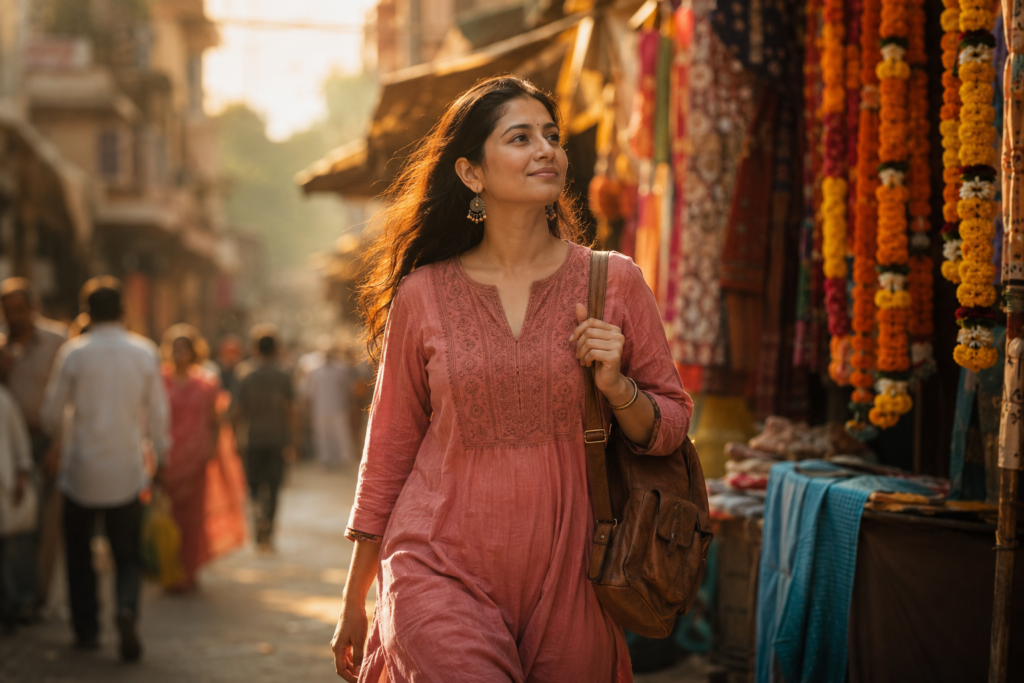
I get this question more than any other. And I understand why — if you’ve Googled “India solo female travel,” you’ve probably come away more scared than informed.
So let me give you the answer I wish someone had given me: honest, grounded, and from someone who actually lives here.
The short answer: yes, India is safe for solo female travelers — with preparation, awareness, and the right mindset.
But that one sentence deserves a lot more context. India is not a monolith. It is 1.4 billion people, dozens of cultures, and thousands of cities and towns that each have their own character. Painting all of it with one brush — safe or unsafe — does you a disservice.
I’ve traveled across India independently — from the narrow lanes of Old Delhi to the ghats of Varanasi, from Jaipur’s crowded bazaars to the quieter backstreets of Fort Kochi. I’ve felt completely at ease in some places and quietly alert in others. That range of experience is normal, and it mirrors what you’d feel in any large, complex country.
If you’re already thinking about how to plan a trip, our guide on best tours to India from America for women is a great place to start.
The fears you’ve probably already Googled
Before we talk about what to actually do, let’s address the fears head-on — because they’re real, and pretending they’re not doesn’t help anyone.
| The Fear | The Reality |
|---|---|
| India is uniquely dangerous for women. Crime against women is everywhere. | India’s challenges are real but concentrated — and millions of women travel here safely every year with awareness and preparation. |
| People will stare, follow, and harass you constantly. | Staring is common — it’s cultural curiosity, not always menace. Unwanted attention is rare when you dress appropriately and move with confidence. |
| Scams target solo Western women specifically. | Tourist scams exist, but they’re predictable and avoidable once you know the patterns. Awareness is your best protection. |
I’m not dismissing these concerns — some have roots in real incidents. But media tends to amplify the extreme, which means the millions of safe, joyful solo journeys through India go unreported. My goal is to give you a balanced picture so you can make an informed decision.
What I’ve learned traveling across India
The single most important thing I’ve come to understand is this: every city in India has safe areas and areas worth avoiding — just like Paris, New York, or London. The question is never “is this entire city safe?” It’s “which neighborhoods, which hours, which situations do I need to be thoughtful about?”
I’ve walked through the Pink City of Jaipur at dusk and felt completely fine. I’ve also learned that wandering into quiet, unlit alleys in any unfamiliar city after midnight is not something I’d recommend — not because India is uniquely dangerous, but because that advice applies almost anywhere in the world. Context is everything.
“The women who have the best experiences in India are not the ones who are fearless — they’re the ones who are prepared. They’ve done a little research, they travel with intention, and they trust their instincts.”
— Chetna, Co-founder, RoamRani
A story that stays with me
One of our guests — a solo traveler from the UK in her early 40s, traveling India for the first time — told us she almost didn’t come. She’d read too many alarming things online.
She arrived anxious, and within three days she messaged us to say she wished she’d come sooner. By the end of her two weeks, she’d bargained at a Rajasthan market, taken a sunrise tuk-tuk to the Taj Mahal, shared chai with a family in Varanasi, and told us it was the most alive she’d felt in years.
What made the difference? She knew what to expect, she had a plan, and she didn’t let fear make her decisions for her.
What actually keeps you safe: my honest tips
Accommodation
Stay in well-reviewed, central properties
Book accommodation with strong recent reviews from solo female travelers specifically. Guesthouses and boutique hotels in main tourist areas tend to have helpful staff who know the area well and can guide you on what to avoid nearby.
Confirm check-in before you arrive
Especially late at night — always have the hotel number saved and a backup plan. Arriving at a new city after dark without confirmed accommodation is the kind of situation that creates unnecessary stress.
Transportation
Use trusted cab services
Ride-hailing apps offer a paper trail and tracked routes, which adds a layer of security. For the most reliable, vetted experience, we recommend booking through RoamRani — our drivers are vetted, our routes are planned, and someone always knows where you are.
Book ladies’ compartments on trains
Indian Railways has dedicated women-only compartments on most trains. They exist precisely because the railway system recognized the need — use them without hesitation. For overnight journeys, book AC sleeper classes where co-passengers tend to be families and professionals.
Tuk-tuks are fine for short daytime trips
Negotiate the fare before you get in. If a driver suggests an “alternative route” or wants to take you to a shop first, firmly say no and step out. This is the most common low-level scam — and it’s very easy to handle once you know to expect it.
What to wear
Dress to blend in, not to disappear
You don’t need to wear a sari — but covering your shoulders and knees in most public spaces (markets, temples, smaller towns) significantly reduces unwanted attention and shows cultural respect. In beach destinations like Goa, norms are more relaxed. Read the room and dress accordingly.
For a detailed guide, read: What to Wear in India as a Tourist →
Nighttime safety
A simple rule: don’t go out late alone unless you have to
This isn’t about fear — it’s just practical. If you want to experience India’s beautiful evening culture (and you should — the lights, the food, the atmosphere), go with a group, stick to well-lit touristy areas, or arrange a trusted driver. The magic of an Indian evening is absolutely worth experiencing with a little planning.
Handling staring and unwanted attention
Staring is usually curiosity, not threat
For many Indians outside major cities, a Western woman traveling alone is genuinely unusual — and people stare at things that are unusual to them. It’s disconcerting at first, but it rarely escalates. Holding your head up and walking with confidence is the single most effective signal you can give.
You don’t owe anyone a conversation
If someone is making you uncomfortable — persistent questions, following you — it is completely acceptable to firmly say “please leave me alone” and walk into the nearest shop or busy space. Crowded markets, hotel lobbies, and restaurants are always safe havens.
Avoiding scams
The most common scams follow patterns
The “helpful local” who wants to take you to a better shop. The rickshaw driver who says your hotel is closed. The gem dealer who offers an extraordinary deal. Once you know these exist, they’re remarkably easy to spot. The golden rule: if something feels too helpful or too good, pause and think.
Always agree on a price before you commit
For auto-rickshaws, local tours, and market purchases — name your price or confirm theirs before you accept the service. This simple habit eliminates the vast majority of pricing disputes.
Frequently asked questions
Is India safe for a woman traveling alone for the first time?
Yes — with preparation. First-timers do best when they stay in well-reviewed central accommodation, use vetted transport, travel between major cities during daylight hours, and join a guided itinerary for at least part of their trip. Knowing what to expect takes most of the anxiety out of the experience.
Which cities in India are safest for solo female travelers?
Jaipur, Udaipur, Kochi (Fort Kochi area), Pondicherry, and Mysore consistently receive strong reviews from solo female travelers for their relatively manageable scale, tourist infrastructure, and welcoming culture. Major cities like Delhi and Mumbai are entirely navigable but require more awareness of neighborhood-level context.
What should solo female travelers avoid in India?
Avoid walking alone in unlit, unfamiliar areas after dark. Avoid accepting unsolicited help from strangers at transport hubs (this is typically the start of a tourist scam). Avoid sharing exact accommodation details with people you’ve just met. None of these are India-specific — they’re standard solo travel awareness anywhere in the world.
How do I get around India safely as a solo woman?
Use ride-hailing apps or pre-booked, vetted drivers for city transport. On trains, use women-only compartments (available on almost all routes). For multi-city travel, a curated tour designed for women gives you the freedom of independent travel with the safety of pre-vetted logistics.
Not sure which apps to use? Read our guide: Best India travel apps for solo women →
Is the Golden Triangle safe for solo female travelers?
Yes. Delhi–Agra–Jaipur is one of the most-traveled routes in India and has strong tourism infrastructure. All three cities have well-established tourist areas, reputable accommodation options, and reliable private transport. It’s one of the best starting points for a first solo trip to India.
My honest bottom line
India is complicated, layered, and unlike anywhere else on earth. It will challenge your assumptions, overwhelm your senses, and — if you let it — give you memories that will last a lifetime.
Is it perfect? No. Is it uniquely dangerous? Also no. It is a country that rewards curiosity and preparation in equal measure.
The women I’ve seen thrive here aren’t the ones who arrived without concerns. They’re the ones who arrived prepared.
I believe every woman who feels the pull toward India should go. And I believe the right information — not fear, not false reassurance — is what makes that possible.
Planning a solo trip to India?
RoamRani was built for exactly this — luxury, safety, and a guide who actually knows the country. Browse our handpicked tours designed for women traveling from the US.